
Wood Movement: Why Solid Wood Furniture Moves
By Brian James, General Manager of Madera Furniture Company · Updated October 2026
What it is
Solid wood is a natural material that never stops responding to the air around it. In humid months it takes on moisture and swells slightly; in dry months, especially when the heat is running, it gives moisture back and shrinks. Almost all of this seasonal wood movement happens across the width of a board, very little along its length.
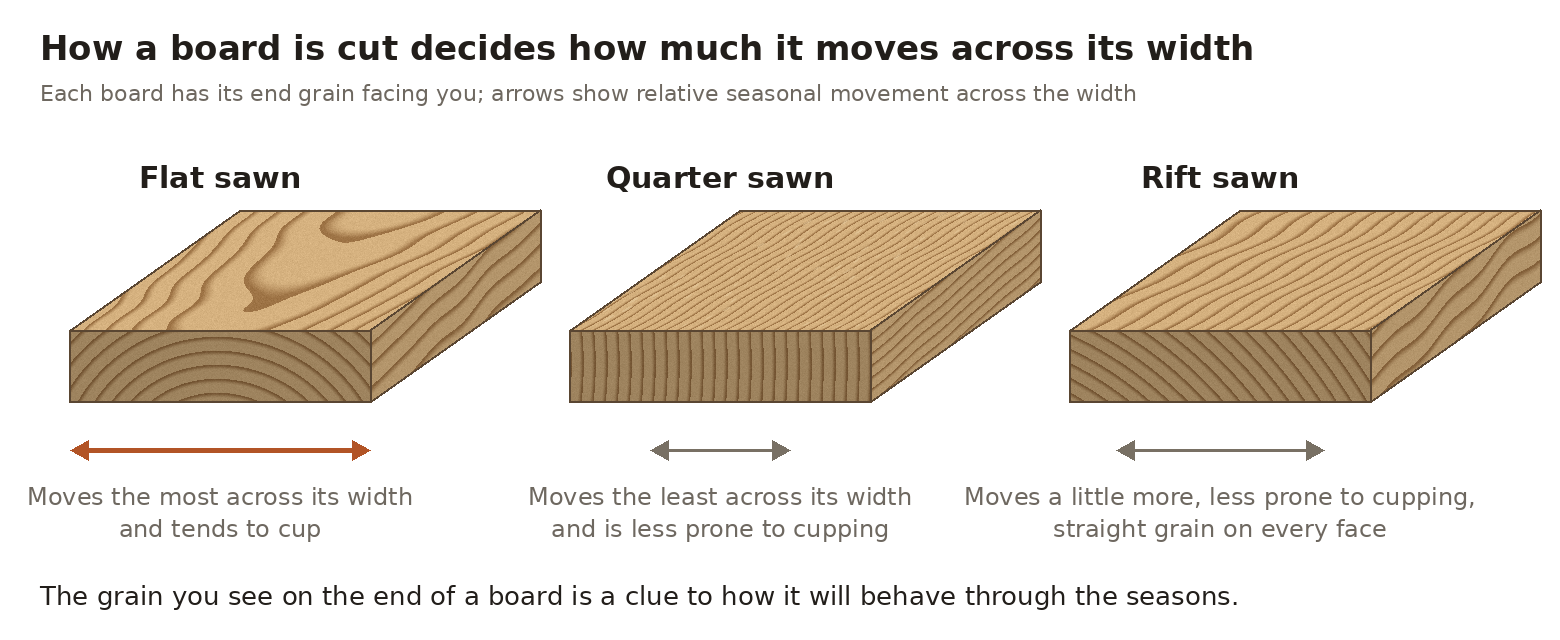
Wood moves most along its growth rings (tangential movement), about half as much across them (radial movement), and very little along its length. So how a board is cut matters. Flat sawn boards have rings running across their width, so they move the most and can cup. Quarter sawn boards have rings standing upright, so they move the least. Rift sawn boards fall between the two in movement across their width and are valued for their consistent, straight grain.
How we build for it
We build every piece in our Tacoma shop for clients across the Pacific Northwest. We choose materials for stability and use construction methods that give solid wood room to expand and contract.
Stable cores. For wide tops, doors and panels, we often use real wood veneer over a stable core such as plywood or MDF. This construction lets us create broad, uninterrupted wood surfaces with far less seasonal movement than solid lumber.
Stable lumber. Where a piece calls for solid wood, we favor rift and quarter sawn boards for wide parts and let lumber acclimate in our shop before we build.
Floating panels. Door and cabinet panels sit in grooves, so they can expand and contract without cracking the frame.
Movement-friendly fasteners. Solid wood tabletops are attached with hardware that lets them move, not screws that pin them in place.
Breadboard ends. On solid wood tables, these keep wide tops flat while still letting them move.
Stable materials help reduce movement; thoughtful joinery allows for it. Together, these choices help your furniture handle seasonal changes without putting stress on panels, joints or frames.
What you might notice
A drawer or door that is snug in humid months and easier in dry ones
Slight changes in how a tabletop sits as the seasons turn
Small seasonal changes can occur, but doors and drawers should remain usable and the piece should stay stable. If something binds, cracks or feels loose, contact us so we can take a look.
How to reduce wood movement in your furniture
Keep indoor humidity steady, ideally between 35 and 55 percent
Keep pieces away from heating vents, radiators, fireplaces and air conditioners
Avoid long stretches of direct sunlight
If something looks beyond normal movement, a large crack or a joint opening up, let us know and we will take a look.
Frequently asked questions
Does solid wood furniture expand in summer?
Yes. In humid months solid wood takes on moisture and swells slightly, mostly across its width and very little along its length.
Is quarter sawn or rift sawn wood more stable than flat sawn?
Yes. Quarter sawn boards move the least across their width and rift sawn boards move only a little more, while flat sawn boards move the most and can cup.
What humidity is best for wood furniture?
Steady indoor humidity between 35 and 55 percent keeps solid wood most comfortable. Avoid placing pieces next to heating vents, fireplaces or air conditioners.
Why is my wood table cupping?
Cupping happens when one face of a board takes on or loses moisture faster than the other, so the board bows slightly across its width. Flat sawn boards are most prone to it, and steady humidity, shade from direct sun and distance from heat sources help prevent it.
Will my solid wood furniture crack?
Cracks are uncommon in a piece built to allow for movement and kept away from heat sources and very dry air. If you notice a crack or a joint opening, contact us and we'll take a look.
Do veneered panels move like solid wood?
It depends on the core beneath the veneer. Plywood and MDF cores expand and contract far less across their width than solid lumber, which makes them useful for wide surfaces. Solid wood edges and frames still need room for seasonal movement.
Is all wood veneer the same?
No. Wood veneer is a thin layer of real wood, but its species, thickness, cut and quality vary. We apply it over stable cores such as plywood or MDF, chosen for the piece and its intended use. Thicker veneers can provide more room for sanding and refinishing later, depending on their thickness, condition and any previous refinishing.
How the veneer is arranged also changes the result. Slip matching places consecutive sheets side by side in the same orientation, creating a repeating grain pattern. Sequence matching keeps related sheets or panels in order, helping the grain and color flow across a series of doors or larger surfaces. These choices can make a substantial difference in the finished piece.
Is wood veneer inferior to solid wood?
No. Well-made veneered furniture can be every bit as refined and durable as solid-wood furniture. Veneer lets us arrange grain across broad surfaces, create distinctive patterns and use beautiful woods efficiently. Paired with a stable core, it also reduces seasonal movement.
Solid wood is well suited to legs, shaped edges and sculpted details. Veneer offers advantages for wide panels, doors and carefully matched surfaces. We often use both in the same piece, choosing each where it works best.
Related: Care & Warranty